

- Push a calculation from Equals, e.g. push forecasted values to “Forecast” field
- Fix incorrect CRM values, e.g. Amount, Stage, or Owner
- Transfer data from one datasource to another, e.g. push Stripe ARR values to Salesforce
Getting started
Setting up a Writeback Destination Regardless of the datasource (i.e., Salesforce or HubSpot), you’ll need to connect it again as a Writeback destination. Here’s how to do that:- Reach out to your Equals CSM to get this functionality enabled
- Once done, navigate to the Datasources page and click on the Writeback tab
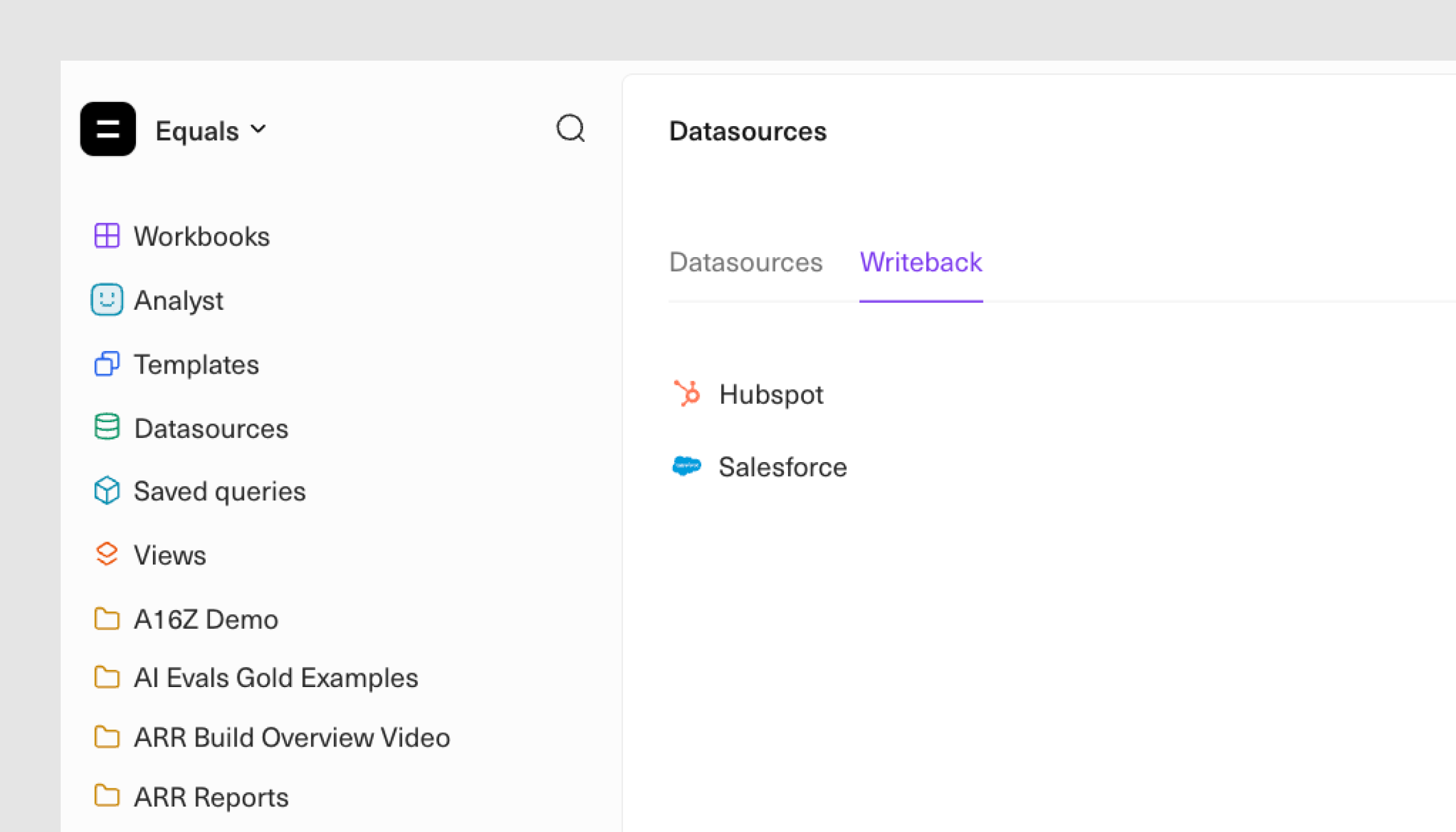
- Click “Create Writeback” → “Connect to [CRM source]”
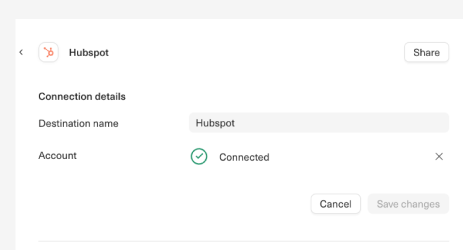
- Sign in to your CRM account
- You should now see “Connected”
- For Contacts → the “Email” property is already unique by default in HubSpot, so the email column in your sheet can be your Primary Key.
- For Companies → the HubSpot > Company > ID field in Equals will be the same as Record_ID in HubSpot. You cannot use HubSpot’s default “Domain” property because it is not unique. If you would like to match on Domain, most teams create a new property called “unique_domain” (with Require Unique Values ON), and then populate it via a HubSpot workflow.
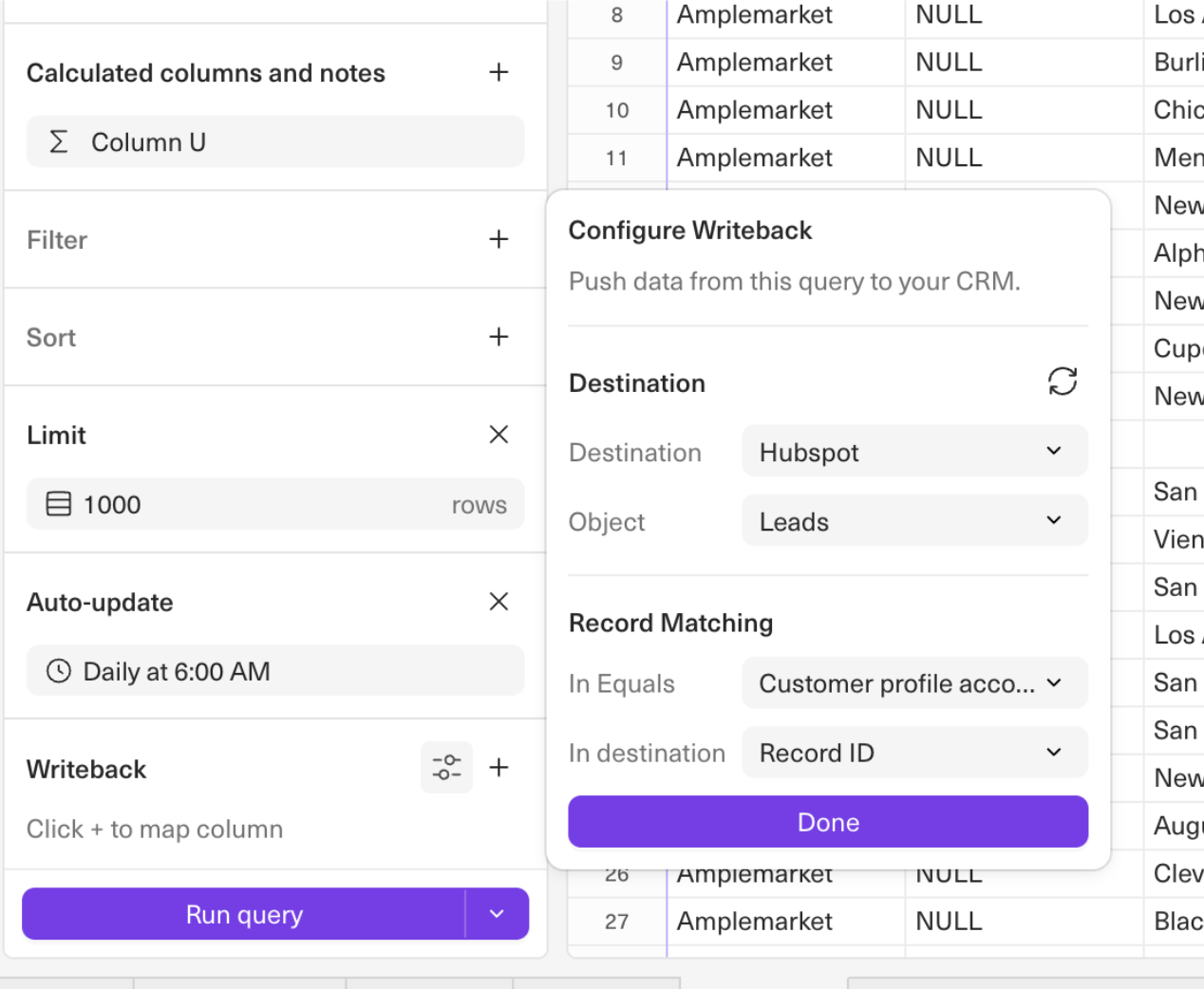
- Click on the Writeback section in the Query Builder or Settings in SQL Editor.
- Select the Destination (datasource) and the Object within that Destination to be written back to. You can only choose one Object per sheet to write back to.
- In Record Matching, select the column name within the Equals datasheet containing the primary key / ID values.
- Then, select the relevant field in the writeback destination with the matching ID values. There is more information on record matching in the section below.
- Select Update & Create (available if the match key is not platform’s internal ID, e.g. it’s not Hubspot Object Id) or Update
- Click on Done to confirm the configuration (Note: Hitting ‘Done’ won’t kickoff anything — this is just configuration step.).
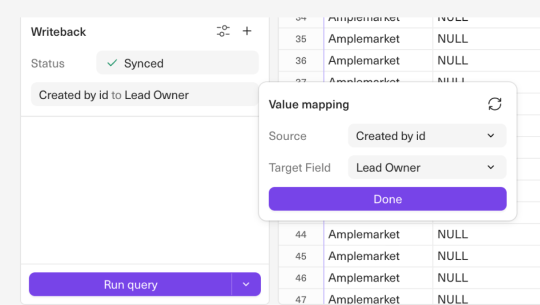
- To define the field(s) to be written back, this will be completed in the Value Mapping section in which Source = column within the Equals data sheet ; Target Field = destination field to be written back to. (Note: Hitting Done will immediately trigger writeback)
- If there are more values you’d like to write back, click the ’+’ next to Writeback and you’ll see the Value mapping popup reappear to plug in those new values.
- HubSpot Object ID (like Record ID) – supports updates only
- A custom unique field – supports both creating new entries and updates, but the field must have “require unique values for this property” enabled
- Salesforce Object ID – supports updates only
- A custom unique field – supports both creating new entries and updates
FAQ
Can I push data to custom objects? Yes, this is possible. If you want to writeback to a custom object, you must first create a custom property under that object. When does the syncing happen? Anytime there is a new row in the table, or when the value in the writeback column changes it will automatically trigger the writeback and push new data to your CRM. Can I manually trigger sync? No, you currently can’t manually trigger the sync. I created a new property but I’m not seeing it as an option in Equals If you just created a new property in HubSpot/Salesforce, click on the Sync (refresh icon) in the Writeback popover to refresh the schema. Can I undo Writeback? You cannot undo any Writeback you have sent, so you should set this up once you’re confident in the information you want to push. Are blank / empty values synced? No, blank values are not written to the destination.Have more questions?
Reach out. We’re always happy to lend a hand!Plausible.io Querying data